How to Keep a Post-Match Journal You Will Actually Use
Keep a post-match journal with a practical template, a worked tennis example and a simple way to turn match notes into your next training task.
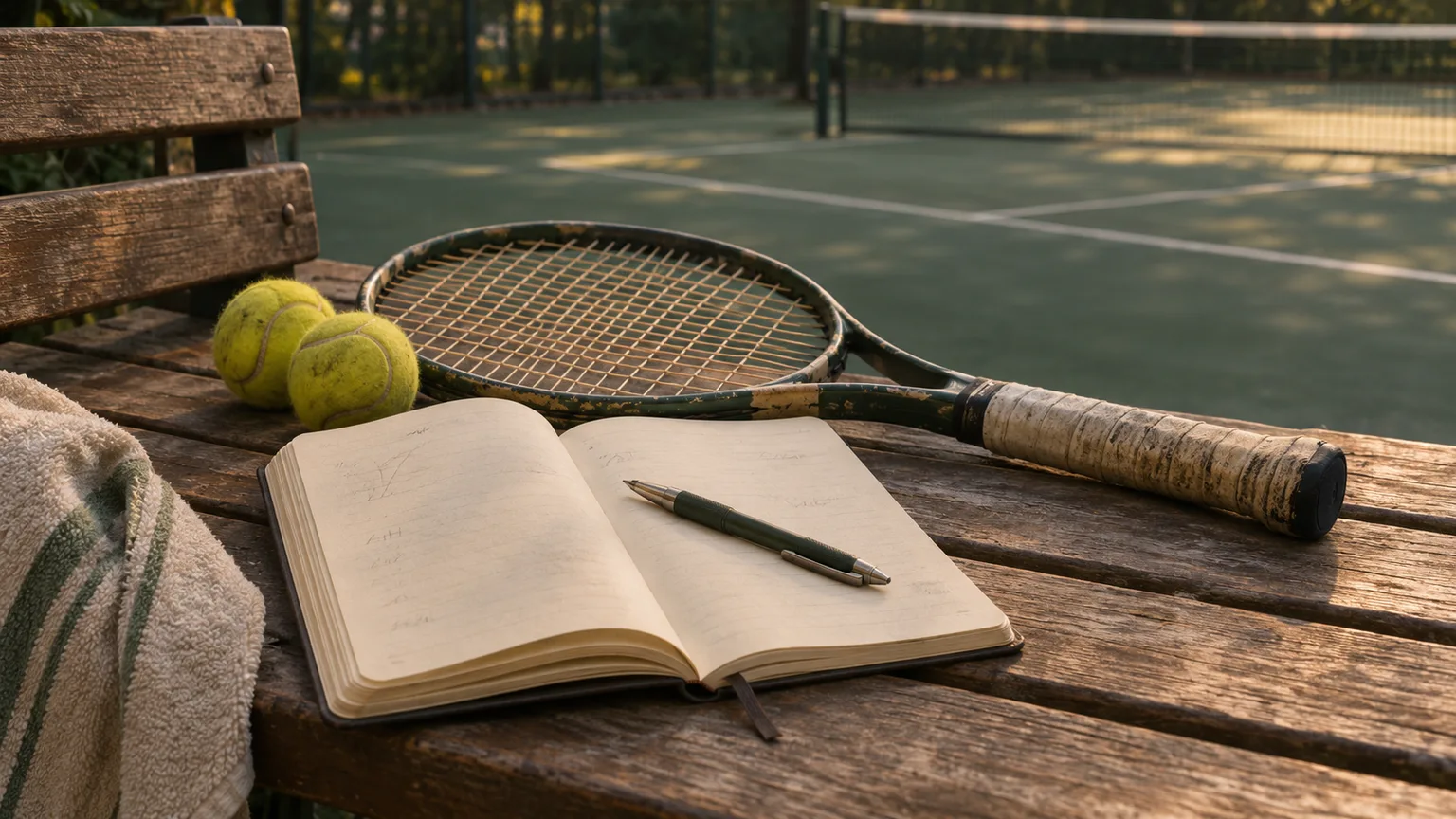
A useful post-match journal records what happened, what you want to keep doing and one thing to practise next. Write a short note once you have space to think, then read it before the relevant training session or rematch. Paper is enough; an app becomes useful when you need to find observations by opponent rather than by date.
The aim is to leave a practical message for your future self. “I played badly” gives that future self very little to work with; “I tried to finish the point from behind the baseline” identifies a situation you can discuss and practise.
This guide offers a copyable template, a fictional tennis example and a routine for returning to your notes. The template is an editorial suggestion, not a validated performance intervention, and the examples are illustrations rather than individual coaching advice.
What is worth remembering after a match?
Start with the part of the match that still raises a question. You do not need a full account of every point, a complete statistical analysis or a verdict on your character.
Separate the event from your explanation.
“I missed two returns in the final game” describes something you remember. “I missed because I cannot handle pressure” adds an explanation that the note alone cannot establish.
A more useful second sentence might be: “I remember taking a bigger swing than earlier; check the video if available.” That gives you a way to investigate the thought without pretending you already know the answer.
Preserve something that worked.
A loss can include a good adjustment, a well-chosen shot or a routine you want to repeat. A win can include decisions that happened to go unpunished.
Record both with the same care. Otherwise your journal may become a catalogue of faults after losses and a score archive after wins, with neither giving much guidance for practice.
Choose one question for the next session.
“Improve everything” is hard to act on. “Ask my coach to look at my return position against a wide serve” creates a specific conversation and keeps the observation tied to its context.
You can keep other questions in the note, but give one priority. Choosing a focus is an organising decision for this routine, not a claim that athletes should train only one skill at a time.
A post-match journal template you can copy
Allow about five minutes for a first attempt. That is a convenient limit to try, not a research-backed minimum or an obligation to write before you have recovered.
- Context: Date, opponent, score and any condition that matters for interpreting the match.
- One moment: What happened, and what did I actually notice?
- Keep: Which decision or action would I like to repeat?
- Question: What am I unsure about? What evidence could help?
- Next practice: What will I try or ask my coach to observe?
- Return to this note: Before which session or opponent will I reread it?
Use ordinary language. If you cannot remember a detail, write “not sure” rather than supplying a precise-looking number; three clearly remembered points are not necessarily representative of an entire match.
The context line is especially helpful when comparing encounters weeks apart. A different surface, format or physical limitation may make an earlier observation less relevant, even against the same opponent.
Keep emotions in the entry if they matter to you. “I felt frustrated after the long game” can sit beside a factual description without becoming proof that frustration caused every later mistake.
For readers starting any kind of diary, our guide to starting a journal offers ways to keep the writing manageable. You can begin with just the moment and the next practice task, then add detail when it serves a purpose.
What does a completed entry look like?
Here is a fictional singles tennis example. It illustrates how to describe an observation without treating a coaching hypothesis as a fact.
Context: Saturday practice match against Sam. Lost 4–6, 4–6 on an outdoor hard court. Wind changed during the second set.
One moment: At 4–4 in the second set I remember two returns going long. I tried to hit both firmly, but I am not sure where I was standing.
Keep: Earlier in the set I used a higher return through the middle and gave myself time to start the rally.
Question: Was my return position part of the problem, or did I choose an unsuitable shot? Check those points with my coach if we have video.
Next practice: Ask a partner to vary serve placement. Compare return choices with my coach and record what we notice.
Return to this note: Before the next return-practice session and before playing Sam again.
The note does not declare that Sam has a permanent weakness or that one technical correction will fix the player’s return. It preserves a small observation and proposes a way to examine it.
After practice, add a short follow-up to the original question. For example: “We tried two return positions; I want more practice before choosing one for matches.” An unresolved question is a legitimate outcome, especially when you have tested it only briefly.
For another opponent-based sport, change the situation and practice question to fit its demands. Keep the distinction between what you observed and what you think caused it.
Ask a qualified coach to help translate the observation into suitable practice. A generic template cannot account for your skill level, technique, training load or injury history.
When should you write, and when should you stop?
Give immediate recovery and practical needs priority. You do not have to analyse the match while still upset, rushing to leave or preparing for another round.
In a 2024 USTA discussion of learning from losses, former professional Christina McHale described taking time after matches before discussing positives and areas for improvement with her coach. This is an athlete’s account of a routine, not a controlled test of journaling.
On a busy tournament day, record the score and a few words that will bring back the relevant moment. Expand them later if useful; an unfinished entry is preferable to inventing a detailed account when you cannot remember it.
Set a stopping point if reflection turns into repeatedly replaying the same mistake. You might close after naming one question, leave it unanswered for the evening and return with a coach when ready.
For younger athletes, adults can invite a conversation without demanding access to every private feeling. Agree what is for the athlete alone and what they would like to share about practice.
A diary is not an injury assessment or mental-health treatment. Persistent pain, distress or difficulties affecting daily life deserve qualified support; no journal entry or app suggestion is a reason to train through pain.
What does research actually say about reflection in sport?
There are reasons to study reflection, but the evidence should not become a promise attached to a notebook or subscription. Two studies show why those distinctions matter.
An older study by Tynke Toering and colleagues at the University of Groningen, published in the Journal of Sports Sciences in 2009, examined self-regulation in 444 youth football players. Higher questionnaire scores for reflection and effort were associated with a higher playing level.
That was an association in players aged 11–17, not a trial assigning athletes to keep this journal. It cannot tell us that writing caused the difference or that an adult recreational player would obtain the same result.
Alexander Latinjak of the University of Suffolk and colleagues reported a 2018 experiment in Sports involving 34 participants and cycling tasks. An intervention involving reflection on self-talk did not produce a statistically significant improvement in time to exhaustion compared with the control group.
That experiment concerned self-talk and a laboratory endurance task, not match journals or OpponentBook. It nevertheless gives a useful reason to avoid assuming that more reflection automatically means better performance.
For this guide, the practical test is narrower: does your note help you retrieve a specific observation and decide what to discuss or practise? You can assess that usefulness without claiming that a change in your win rate proves the journal worked.
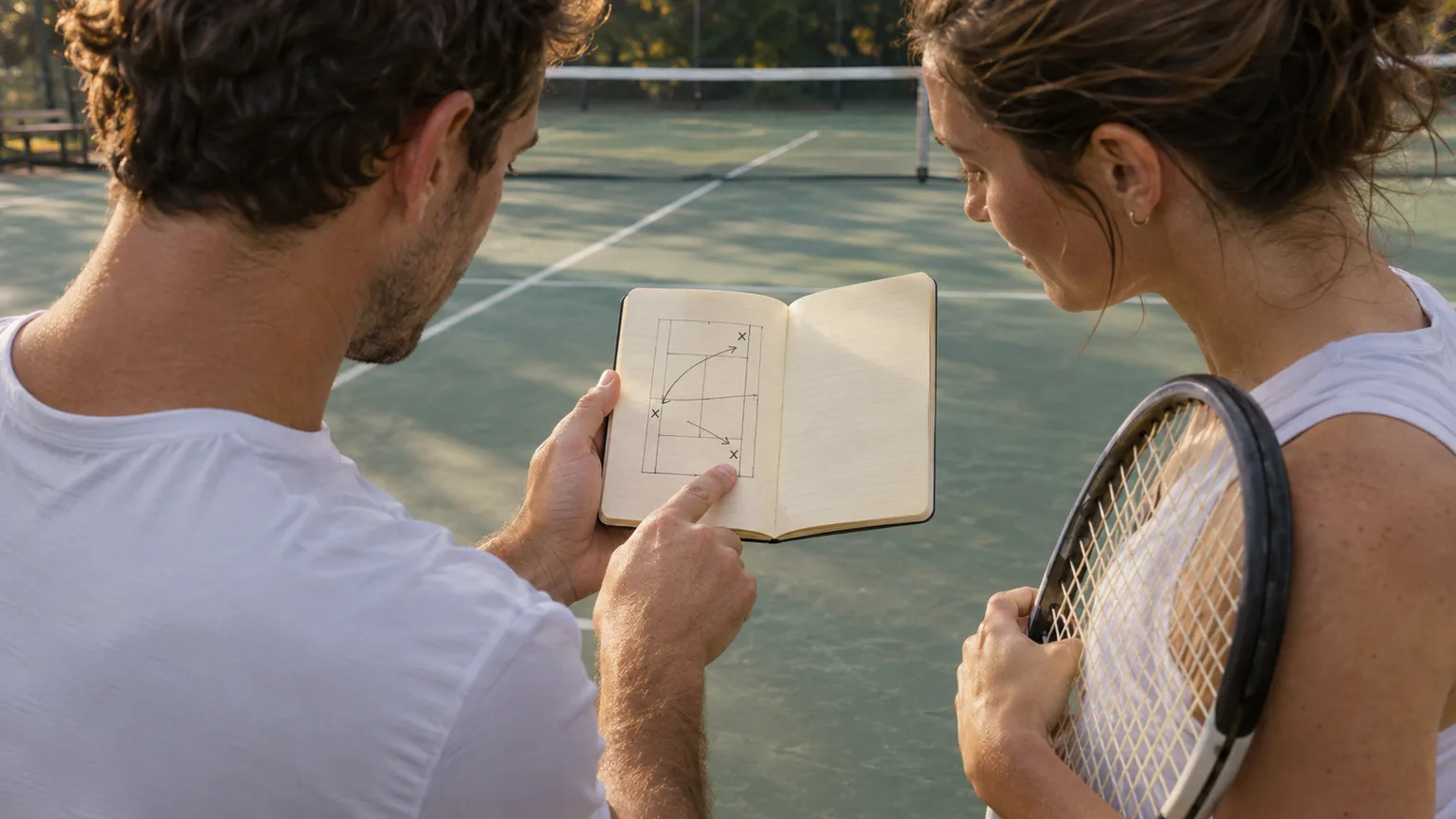
How do you turn notes into the next training session?
Before practice, open the most relevant entry and read the question you left yourself. Decide whether it still matters in today’s session and whether your coach or partner can help explore it.
Make the task observable.
“Be more confident” describes a wish. “Explain my return choice after each practice point and compare it with my coach’s observation” specifies something you can actually do and discuss.
The measure does not have to be a percentage. A brief account of what changed, what stayed difficult and what you want to try again may be more useful than a number collected under inconsistent conditions.
Close the loop after practice.
Add one sentence about the task to your training note. If your initial explanation seems less plausible, keep that correction visible rather than rewriting the earlier entry as though you had known all along.
Before a rematch, look for a relevant observation and a reminder about your own decisions. An opponent can change; treat older notes as questions to revisit rather than instructions that must work again.
A weekly review can be short too. Pick a recurring question across a few entries, notice an action you want to keep and remove a task that no longer makes sense.
Do not judge the habit only by consecutive days written or by results after a handful of matches. Opponents, conditions and practice all change, so the journal is a record for discussion rather than a controlled experiment.
Should you use paper, a notes app or OpponentBook?
Choose the place where you can find the note again. The template works on paper, in an ordinary notes app or in a specialised sports journal.
A notebook suits readers who prefer handwriting and want a simple place to think. Add a small index of opponents or page numbers if finding older observations becomes difficult.
A general notes app suits readers who already keep everything on their phone. A consistent title such as “date — opponent — event” can be enough; avoid building an elaborate filing system before you know what you need.
OpponentBook is worth considering when you repeatedly face opponents and want their records, match reflections and training notes together. Its official site lists those core journal features in the free tier, checked on 6 November 2026.
To try this routine there, put the match observation with the relevant opponent and use your training note for the practice task. The template above is our suggested writing structure, not a claim that OpponentBook provides those exact six fields.
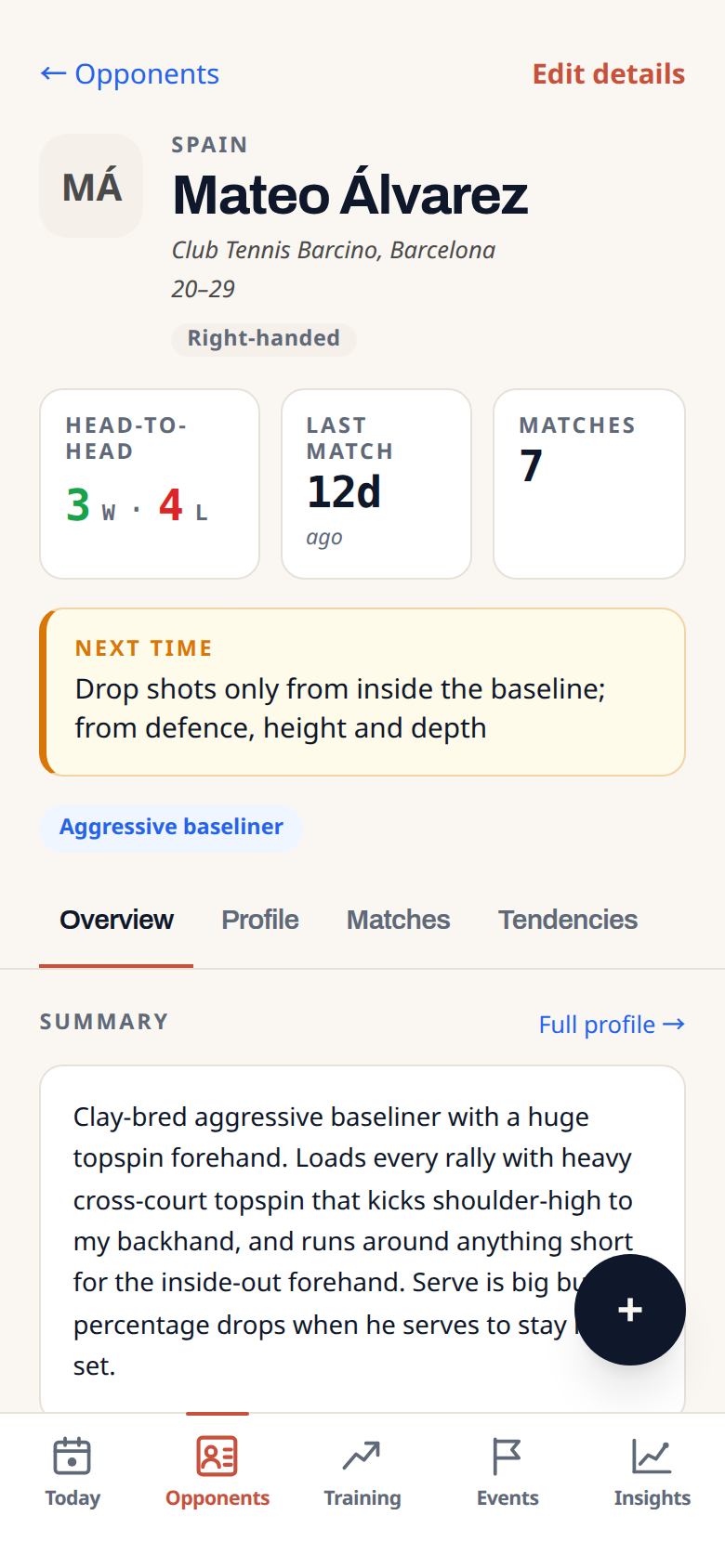
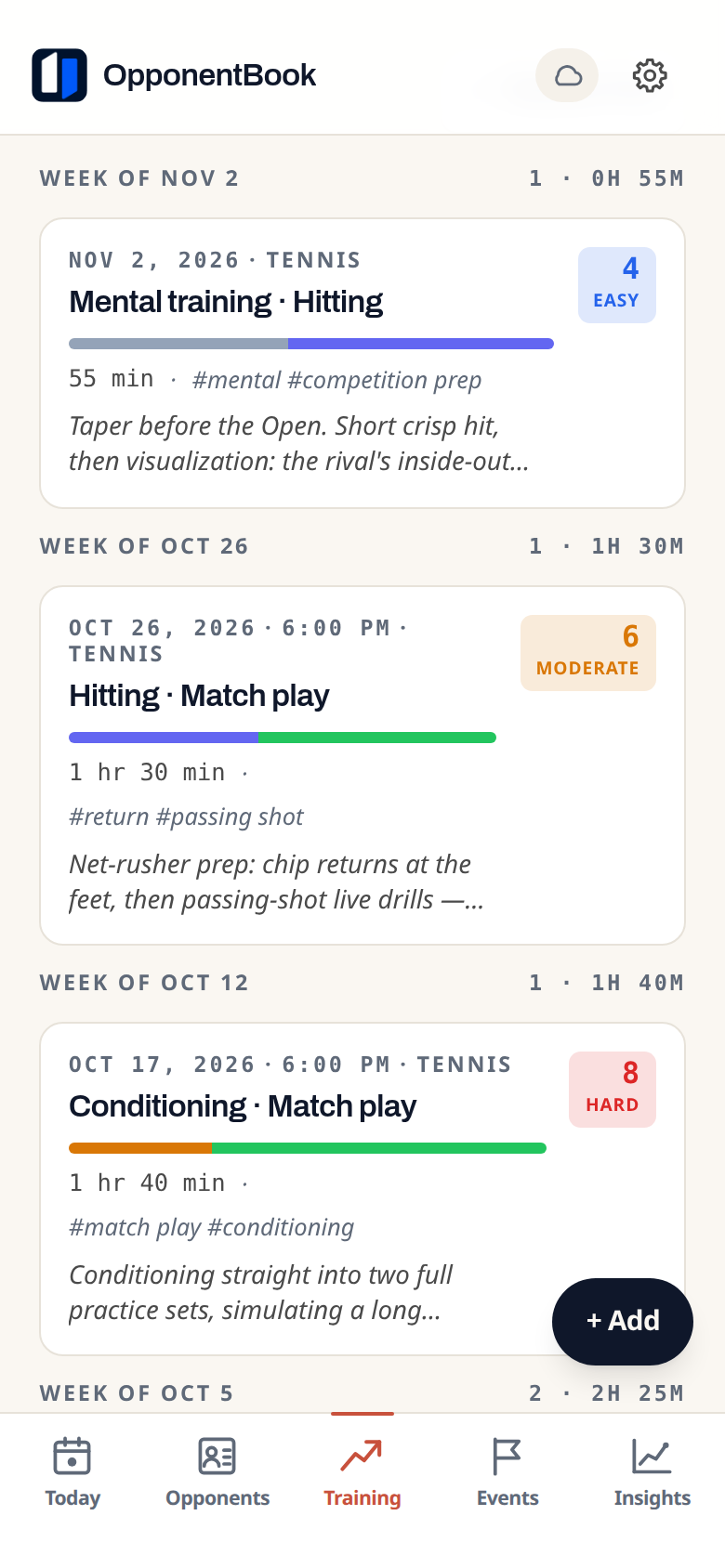
The attraction is being able to return to the sporting context of a note. You do not need paid analysis or AI to try the habit, and this recommendation is not evidence that the app improves results.
For a broader comparison of workflows, see our guide to journaling apps for athletes. Choose a general diary instead if you mainly want to explore how sport fits into your wider life.
Before sharing notes with a coach, select what is useful for that conversation. Keep speculative personal judgements about opponents out of shared records and check storage and sharing arrangements using our journaling-app privacy guide.
The useful part is the return visit
A match journal earns its place when a previous observation becomes available at the moment you need it. A detailed entry that you never reopen may be less useful than three lines you bring to practice.
After your next match, copy the template into your chosen notebook or app and fill in one moment, one action to keep and one question. Put the date of your next relevant session beside it so you know when to open it again.
Frequently asked questions
What should I write in a post-match journal?
Record the match context, one moment you can describe, something worth repeating and one thing to practise. Keep observations separate from explanations and decide when you will reread the note.
How long should a match reflection take?
Try five minutes as a practical starting point, not a scientifically established dose. A brief note is enough on a busy day; return to it when you have time and feel ready.
Should I write after wins as well as losses?
Yes. Record useful decisions after wins too, and preserve what went well in a loss. The result alone cannot tell you which decisions to repeat.
Do I need an app for a sports journal?
No. Paper or a notes app can hold the template. OpponentBook is an option when you want opponent records, match reflections and training notes organised together.
Will journaling improve my results?
That is not established for this template or any app recommended here. Research on reflection offers reasons to investigate the habit, but does not guarantee better sporting performance.